
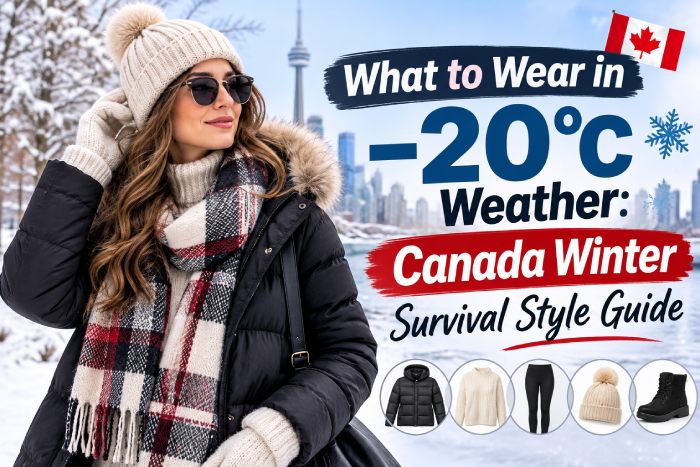
Quick Answer: To survive –20°C in Canada, wear a 3-layer system: (1) a moisture-wicking thermal base layer (merino wool or synthetic — never cotton), (2) an insulating mid layer like fleece or a puffy down jacket, and (3) a windproof, waterproof outer shell rated to at least –20°C. Complete the outfit with insulated waterproof boots, wool socks, a toque, mittens, and a neck gaiter. Skin exposure at –20°C can cause frostbite in under 30 minutes, so cover every inch.
Why –20°C Is a Different Beast Entirely
If you’ve never experienced a true Canadian winter, –20°C isn’t just “cold” — it’s a physical environment your clothes must actively fight. At this temperature, the air itself pulls heat from your body, and even a light wind can make it feel like –30°C or worse (that’s wind chill).
The good news? Canadians have survived this for generations, and the formula is simple: layers, the right fabrics, and zero exposed skin.
Rule #1 of Canadian winter: Cotton kills. Cotton absorbs sweat, stays wet, and then freezes against your skin. Every layer touching your body should be wool or synthetic.
The 3-Layer System: The Foundation of Everything
| Layer | Purpose | What to Wear | Avoid |
|---|---|---|---|
| 1. Base Layer | Wicks sweat off your skin | Merino wool or synthetic thermal (long johns + thermal top) | ❌ Cotton, regular T-shirts |
| 2. Mid Layer | Traps body heat | Fleece jacket, down sweater, or synthetic puffer | ❌ Thin hoodies alone |
| 3. Outer Shell | Blocks wind, snow & water | Waterproof/windproof parka rated –20°C to –30°C | ❌ Fashion coats, denim jackets |
Pro tip: The genius of layering is adjustability. Heated bus → freezing sidewalk? Peel a layer. Heading into the wind? Zip everything up.
Head to Toe: Your Complete –20°C Outfit Checklist
🧠 Head: Your Greatest Heat Escape Route
You lose significant heat through your head, so start here:
- Toque (beanie) — wool or fleece-lined, covering your ears
- Neck gaiter or scarf — a gaiter stays put better in wind; a loose scarf can be pulled up over your nose
- Bonus: In wind chill below –25°C, consider a balaclava — it looks intense but your face will thank you
🧥 Torso: Where the Layering System Lives
- Base: Merino wool thermal top (150–250 weight)
- Mid: Fleece or packable down sweater
- Outer: A parka, not a jacket. Look for:
- Temperature rating of –20°C or lower on the label
- Length that covers your hips/upper thighs (Canada’s cold targets your core)
- A hood with a removable fur or faux-fur ruff (the fur breaks up wind around your face — this is genuine Arctic-tested tech)
- Storm cuffs at the wrist
- Popular categories: Canadian-made parkas (Canada Goose, Moose Knuckles, Nobis) or technical options (Arc’teryx, The North Face, Columbia, Helly Hansen). A solid mid-range parka ($200–400 CAD) handles most Canadian cities fine.
🧤 Hands: Mittens Beat Gloves — Every Time
Fingers stay warmer together. At –20°C:
- Insulated mittens are the gold standard (look for down or PrimaLoft fill)
- Gloves are acceptable only if they’re heavily insulated and you need finger dexterity
- Add disposable hand warmers in each mitten for brutal days — they last 8+ hours
👖 Legs: Don’t Neglect the Bottom Half
- Thermal long johns (merino or synthetic) under your pants
- Outer pants: Insulated snow pants only if you’re doing winter activities; otherwise thick jeans or softshell pants over thermals work for city walking (jeans alone at –20°C are a hard no)
- For outdoor work/sports: Full insulated bib pants
🧦 Feet: Where Most People Fail First
Cold feet ruin everything. Get this right:
- Socks: One pair of thick merino wool socks (not two thin pairs — that compresses and cuts circulation)
- Boots: Insulated, waterproof winter boots with:
- Temperature rating of –20°C to –40°C
- Non-slip lugged rubber outsole (ice is the real enemy)
- Room to wiggle toes (tight boots = cold feet)
- Trusted categories: Sorel, Kamik, Baffin, Columbia Bugaboot
- Ice cleats/traction aids slip over boots for icy sidewalks — common sights in Toronto and Montreal
🧴 Skin & Face (Yes, Skin Care Counts)
- Lip balm + moisturizer — dry, heated indoor air plus biting wind wrecks skin
- Cover cheeks and nose in high wind; frostbite loves these spots
What to Wear by Activity Level
| Activity | Adjust This |
|---|---|
| City walking / commuting | Standard 3-layer system + parka |
| Waiting for the bus (static) | Add warmer mid layer + hand warmers |
| Hiking / snowshoeing (active) | Lighter base + breathable shell — you’ll sweat; pack the parka for stops |
| Driving | Never wear a thick parka under the seatbelt; use layers you can remove in the car |
Warning Signs: Frostbite and Frostnip at –20°C
Frostbite can begin in under 30 minutes of exposed skin at –20°C with wind. Know the signs:
- Frostnip (early stage): Skin turns pale or red, feels tingly or numb — reversible with warming
- Frostbite: Skin turns waxy, white, or gray; numbness persists — seek medical help
Immediate response: Get indoors, warm skin gradually (warm — never hot — water), and never rub frostbitten skin.
Keep an emergency blanket, extra gloves, and a candle in your car. Every winter, Canadians get stranded in vehicles — being prepared is part of the Canadian style.
Budget-Friendly Canada Winter Shopping Strategy
You don’t need a $1,500 Canada Goose to survive. Prioritize spending like this:
- Boots first (wet/cold feet end your day fastest) — $100–180
- Merino base layer — $40–80
- Insulated mittens + toque + gaiter — $40–60 total
- Mid-range parka rated –20°C — $200–350
Check end-of-season sales (February–March) and stores like Sport Chek, MEC, Decathlon, and Uniqlo (heat-tech base layers) for serious value.
Frequently Asked Questions (FAQ)
Can you survive –20°C without a parka?
Technically yes with heavy layering, but a windproof shell is what traps your heat in windy conditions. Without wind protection, even thick layers fail. A proper –20°C-rated parka is the single most important purchase.
Is –20°C the same in Toronto and Edmonton?
No. Dry cold (Edmonton, Winnipeg, Ottawa) often feels more manageable because sweat evaporates. Humid cold (Toronto, Vancouver-adjacent, Montreal) penetrates clothing and feels colder at the same thermometer reading. In humid cold cities, waterproofing matters even more.
Are jeans okay in –20°C?
Only with thermal long johns underneath. Jeans alone offer almost zero insulation and hold moisture — a common mistake newcomers make.
What is the difference between –20°C and –20°C “feels like” (wind chill)?
Thermometers measure air temperature; wind chill estimates heat loss on exposed skin. At –20°C with 20 km/h wind, it can feel like –33°C, and frostbite risk drops to ~10 minutes on exposed skin.
Do I need expensive Canada Goose jacket for Canadian winter?
No. Any parka rated to –20°C or lower with windproof, waterproof shell works. Canadian-made brands are premium but not required — many Canadians wear Columbia, The North Face, or Noize parkas all winter.
How many layers should I wear in –20°C weather?
Three functional layers minimum: moisture-wicking base (wool/synthetic), insulating mid (fleece/down), and protective outer shell (wind/waterproof). Add or remove mid layers based on your activity level.
Final Checklist Before You Step Out
✅ Merino/synthetic base layer top + bottom
✅ Fleece or down mid layer
✅ –20°C-rated waterproof parka with hood
✅ Insulated waterproof boots (rated –20°C or lower)
✅ Wool socks + hand warmers
✅ Toque covering ears
✅ Mittens (not gloves)
✅ Neck gaiter/scarf + lip balm
✅ Layers you can remove if you overheat
Master the layering system, respect the wind chill, and cover every inch of skin — and –20°C stops being survival mode and starts being just another Canadian Tuesday. Stay warm out there. 🍁❄️