
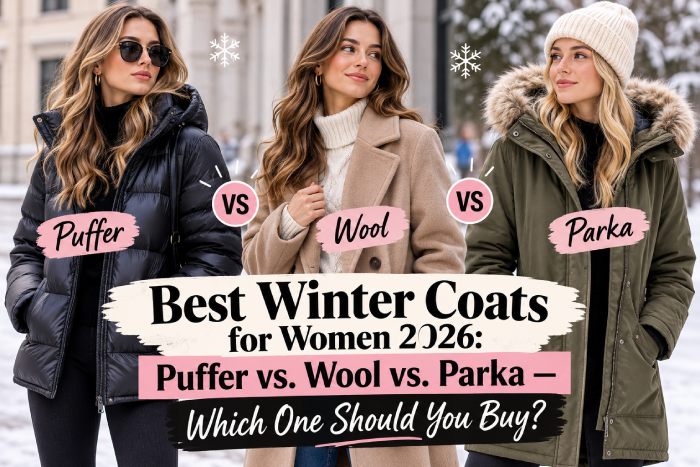
Quick answer: Choose a puffer coat for lightweight everyday warmth, a wool coat for polished city style, and a parka for freezing temperatures and harsh winter conditions. Below, we break down exactly how each one performs — so you buy the right coat the first time.
Every winter, the same question comes back: “Which coat will actually keep me warm without ruining my outfit?” With temperatures dropping across the US and Canada, we’ve compared the three most popular winter coat styles for 2026 — puffers, wool coats, and parkas — on warmth, weather protection, style, and value.
🧥 1. The Puffer Coat: Lightweight Warmth Champion
A puffer coat is a quilted jacket insulated with down feathers or synthetic fill. Its signature “puffy” look comes from stitched sections (called baffles) that trap heat.
Why Women Love Puffers in 2026
- Best warmth-to-weight ratio — premium down puffers keep you warm without the bulk
- Packable — many compress into a small bag, perfect for travel
- Cropped, mid, and long lengths available for every body type and style
Downsides to Know
- Down loses insulating power when wet (unless it’s hydrophobic-treated)
- The sporty look doesn’t suit every occasion
- Cheap puffers flatten out after one season
Best For
Mild to cold winters (roughly 15°F to 40°F / -9°C to 4°C), city commuting, travel, and layering.
What to Look For
- Fill power of 600 or higher for freezing temperatures
- Hydrophobic down if you live in wet-snow regions like the Pacific Northwest or coastal Canada
- Recycled insulation — a major 2026 trend, with more brands offering sustainable fills
🧥 2. The Wool Coat: Timeless Style, Serious Polish
A wool coat is a tailored, single or double-breasted overcoat made from wool or wool-blend fabric. It’s the most polished option of the three — and a staple of every fashion editor’s winter wardrobe.
Why Women Love Wool Coats in 2026
- Instantly elevates any outfit — jeans, workwear, or evening looks
- Naturally breathable and surprisingly warm for its weight
- Long lengths are trending — stylists agree a full-length tailored coat looks the most effortless and chic
Downsides to Know
- Not waterproof — heavy snow and rain will soak through
- Needs layering underneath in sub-freezing weather
- Higher maintenance: dry cleaning only, and it can pill over time
Best For
Dry cold winters (20°F+ / -6°C+), office wear, dates, dinners, and anyone who prioritizes style.
What to Look For
- Wool content of 60%+ (or a wool-cashmere blend for luxury softness)
- Knee-length or longer for maximum warmth and the 2026 look
- A relaxed or belted silhouette — oversized tailoring is this season’s defining trend
🧥 3. The Parka: Built for Real Winter
A parka is a long, hooded, heavily insulated coat designed for extreme cold. It’s the warmest category of the three — the coat you reach for when the forecast says “feels like -20°F.”
Why Women Love Parkas in 2026
- Maximum coverage — many fall to mid-thigh or knee, protecting your core and hips
- Storm-ready features: insulated hoods, fur or fleece-lined ruffs, two-way zippers, storm flaps
- Handles wind, snow, and freezing rain better than any other coat style
Downsides to Know
- Heavier and bulkier than puffers or wool coats
- The technical look skews casual
- Premium parkas can be a serious investment ($300–$1,500+)
Best For
Canadian winters, the US Midwest and Northeast, dog walking, sledding, and anyone outdoors for long stretches in deep cold.
What to Look For
- Temperature rating — brands like The North Face, Aritzia, and Quince publish the lowest temp each coat handles
- Synthetic insulation for wet climates (it stays warm when damp); down for dry, frigid cold
- A two-way zipper and side vents for easier movement and sitting
⚖️ Puffer vs. Wool vs. Parka: Quick Comparison Table
| Feature | Puffer | Wool Coat | Parka |
|---|---|---|---|
| Warmth | ★★★★☆ | ★★★☆☆ | ★★★★★ |
| Weather Protection | Good (if treated) | Poor in rain/snow | Excellent |
| Style Level | Casual-sporty | Most polished | Utilitarian |
| Weight/Bulk | Lightest | Medium | Heaviest |
| Best Climate | Cold, dry | Mild-dry cold | Extreme cold, wet |
| Price Range | $100–$400 | $150–$600 | $200–$1,500+ |
| Care | Machine wash (some) | Dry clean only | Spot clean / follow label |
🗺️ Which Coat for Which Region? (US & Canada Guide)
- Pacific Northwest / Coastal BC (wet winters): Waterproof parka or synthetic-insulated puffer
- Northeast US / Toronto & Montreal (cold, snowy): Down parka or long puffer
- Midwest / Prairies (frigid, windy): Heavy parka rated below 0°F
- Southern US (mild winters): Wool coat or light puffer — a parka is overkill
💰 How Much Should You Spend on a Winter Coat?
- Under $200: Great budget puffers (like Columbia) and fashion wool-blend coats — expect 2–4 seasons of wear
- $300–$500: The sweet spot — quality down parkas and premium wool coats that last 5+ years
- $600+: Premium performance (expedition parkas, designer tailoring) — worth it only for extreme climates or if coat longevity matters to you
❓ Frequently Asked Questions
What is the warmest type of winter coat for women?
A down-insulated parka is generally the warmest. Look for a temperature rating and at least 600-fill-power down (or heavy synthetic insulation) for sub-freezing conditions.
Is a wool coat warm enough for Canadian winter?
On its own, a wool coat suits Toronto-style winter days around 20–32°F (-6 to 0°C). For colder days or the Prairies, layer a thermal base and sweater underneath — or choose a parka.
How do I know if a winter coat is warm enough?
Check the temperature rating if the brand publishes one. Otherwise, look for 600+ fill power (down) or high gram-weight synthetic insulation, plus a length that covers your hips.
Can you wear a puffer coat to the office?
Yes — in 2026, sleek, matte-finish long puffers in neutral colors (black, camel, espresso) are office-appropriate in most US and Canadian workplaces.
🎯 The Bottom Line
There’s no single “best” winter coat — only the best coat for your climate and lifestyle:
- Buy a puffer if you want lightweight warmth and versatility
- Buy a wool coat if style comes first and winters are mild
- Buy a parka if you face real winter — the kind with wind chills, snowbanks, and dog walks at 6 a.m.
Whichever you choose, invest in quality insulation and the right length. A great winter coat isn’t an expense — it’s five winters of warmth.